How can Science and Technology activities be made engaging and relevant in Primary Education?
"The science of today is the technology of tomorrow"
- Edward Teller
 Science and technology within primary education has become more identified through the Successful Futures curriculum. This particular area of learning and experience capitalises on children and young people about the natural, physical world and universe through explaining, investigating and understanding the subject. They learn to generate and test ideas, gather evidence, make observations, carry out practical investigations, and communicate with others. They also learn how through computer science, the horizons of what is possible can be extended beyond our current imagination (Donaldson, 2015, p. 50). Through the art of technology, schools will provide children and young people with rich opportunities to develop technological skills, knowledge, understanding and attributes through designing and developing products and systems. This will allow children to explore the impact of technology on society and the environment (Donaldson, 2015, p. 50). In comparison to when I was a student in primary school, I do not have very vivid memories of taking part in science and technology lessons. Not a lot of experiments, not a lot of investigating. Many primary school teachers do not feel sufficiently prepared to teach science and technology, and find it difficult to deal with the questions of students in this area, and rather fall back on highly structured text books (Skamp, 1991; Yates and Goodrum, 1990). As society changes with time, so does the curriculum. Science and technology has become to be more imbedded into the curriculum allowing children to get experience of completing simple, but fun and engaging lessons which can include experiments.
 Ensuring children are engaged in science and technology is important. With the more use of technology being on the brain of many children, adults and educators, there is nothing wrong with bringing everyone into the present with practical experiments to complete. I will be discussing some simple, and inexpensive experiments educators can carry out in their classrooms in relation to science and technology.
First, what is the investigation process? Children will need to make an estimate or prediction of what they think will happen during the experiment. Making them aware of the method will allow them to understand what they will do and how will they complete the experiment/investigation. Gathering results is the next process, in order to discuss what results they have uncovered and why these results happened to then finish off with the overall conclusion. Following the investigation process will allow children to work togther with peers, whilst using literacy, numeracy and creativity skills.
 Mentos and coke: the classic experiment. I never completed this within a classroom environment, but with friends in my street when I was younger - surely everyone has done this! Teachers complete this experiment in effort to release carbon dioxide, as this is what makes the fizz in coke. The Mentos has thousands of tiny pits all over the surface which acts as nucleation sites, which allows carbon dioxide bubbles to form. As soon as the mentos hit the coke, bubbles form all over the surface of the mints and then quickly rise to the surface of the liquid. The gas released by the Mentos pushes all of the liquid up and out of the bottle, causing an incredible coke blast (Steve Sprangler Science). What will you need for this experiment is simple - a bottle of coke and a packet of mentos.
 - It is recommended to go outside for this experiment due to the mess, so within a schooling environment it should be completed on the play yard or on a large field.
- Carefully open the bottle of coke and place the bottle on the ground in a position it will not tip over.
- Roll up a piece of paper into a tube just big enough to hold the loose Mentos - the goal is to drop 7 Mentos into the bottle of coke at the same time - put the mints into the prepared tube and cover the bottom of the tube with your finger
- Position the prepared tube directly over the mouth of the bottle and drop into the bottle
- Step back from the bottle at a good distance - it's about to get messy!
- Hopefully the Mentos would have hit the bottle, causing a big coke blast to arise from the bottle!
A video of an tutorial of the experiment is down below if you want to give it a watch!

Slime: The slime epidemic has become increasingly popular with children,
watching YouTube videos of other children creating and playing with this
slippery liquid substance. So why not create it as an experiment in the
classroom? The borate ions in the slime activators (sodium borate, borax powder
or boric acid) mixed with PVA (polyvinyl-acetate) glue form slime. The glue is
a polymer and is made up of long, repeating identical strands or molecules
keeping the glue in a liquid state, until adding the borate ions which allows
it all to connect into long strands to keep the mixture all together. Mixing
this all together allows the substance to become less like a liquid, and into a
thicker texture making the slime (Little Bins for Little Hands, 2017). The
equipment/ingredients needed for this experiment are as followed: PVA glue, bicarbonate
of soda, 2 cupfuls of water, food colouring (colour of your preferred choice),
bowl, and spoons.
- Add a cup of glue to the bowl
- Followed by a cup of water
- Add 8 drops of food colouring for a pop of colour to the mixture
- Add another cup of water
- A tablespoon of bicarbonate of soda (sodium borate) needs to be added as our slime activators
- Mix altogether and there you have it - homemade slime!
Want to see someone actually make slime? Here's a video for you to watch:
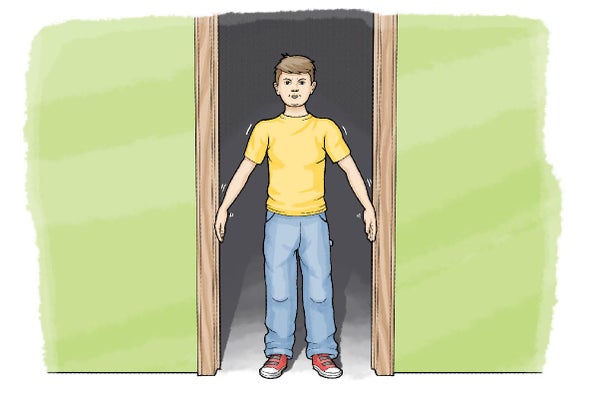 The Floating Arm: I know what you're thinking, what is this activity? Do your arms actually float? I never heard of this until an AOLE lecture, and it really sparked an interest on whether it worked or not. Scientists call this activity the 'Kohnstamm Phenomenon', and it has been researched into what happens in a person's brain and nerve cells when they repress their involuntary movement. This can be done by holding their arms tightly together by their sides instead of letting them float up. There has been two theories explaining how this works - the brain could send a positive 'push down' signal to the arm muscles at the same time as the involuntary 'lift up' signal was being transmitted to cancel the signal out, or the brain could block the involuntary signal completely at the root of the nerves (ScienceMag, 2014). The test is plain and simple - press the back of your hands against the inside of a door frae for 30 seconds, as if you are trying to widen the frame of the door and then release your arms down, where you are expected to feel an odd sensation. It is expected that your arms will float up from your sides, as they are being lifted by force. Having children complete this particular experiment will allow them to predict whether it will work or not.
 You know the drill, a video showing the test in action is down below:
To conclude today's blog post touching on the topic of Science and Technology, I believe that ensuring children are engaged during those particular types of lessons is important. As previously mentioned, during my time in primary education, science lessons were nothing but a distant memory for me, as they were not memorable and was not as hands on. Allowing children to complete investigations, experiements and activities just like the 3 I have talked about today, will allow better engagement and more encourgament to enjoy those particular lessons. Also, completing activities that you know the children will enjoy which are relevent to modern day society, will again allow better engagement on the subject. Will I be applying these activities into Science and Technology into my teaching methods in further years to come? Absolutely!
References:
Donaldson, G. (2015) Successful Futures: Independent review of curriculum and assessment arrangements in Wales. Available at: http://gov.wales/docs/dcells/publications/150225-successful-Futures-en.pdf [Assessed 21 March 2019]
Little Bins For Little Hands (2017). Set Up Science Experiments with Slime. Available at: https://littlebinsforlittlehands.com/how-to-set-up-science-experiments-with-slime/ [Assessed 01 April 2019]
ScienceMag (2014). The Science of the Floating Arm Trick. Available at: https://www.sciencemag.org/news/2014/09/science-floating-arm-trick [Assessed 01 April 2019]
Skamp, K. (1991). Primary science and technology: How confident are teachers? Research in Science Education, 21, 290-299.
Steve Sprangler Science (). Mentos Geyser Experiment. Avaliable at: https://www.stevespanglerscience.com/lab/experiments/original-mentos-diet-coke-geyser/ [Assessed 01 April 2019]
Yates, S., & Goodrum, D. (1990). How confident are primary school teachers in teaching science? Research in Science Education, 20, 300-305.


Comments
Post a Comment